If You Feel Bad About Your Bracket, Here's the Bernoulli Distribution

It's March. Your bracket is in shambles. That 12-seed upset you swore wouldn't happen did happen, your championship pick lost in the second round, and your coworker who picked teams based on mascot cuteness is somehow beating you. Before you spiral into existential doubt about your basketball knowledge, let me introduce you to an 18th-century Swiss mathematician who can explain exactly why this was always going to happen.
Jacob Bernoulli and your busted bracket
Jacob Bernoulli published Ars Conjectandi in 1713, and in it he formalized something deceptively simple: any event that has exactly two outcomes — success or failure, heads or tails, correct pick or wrong pick — follows what we now call the Bernoulli distribution.
Every game in your bracket is a Bernoulli trial. You either pick it right (success, with some probability p) or you pick it wrong (failure, with probability 1 − p). That's it. No partial credit. No "well, I had the right team but the wrong round." Binary. Merciless.
Formally, if X is a random variable representing a single game prediction:
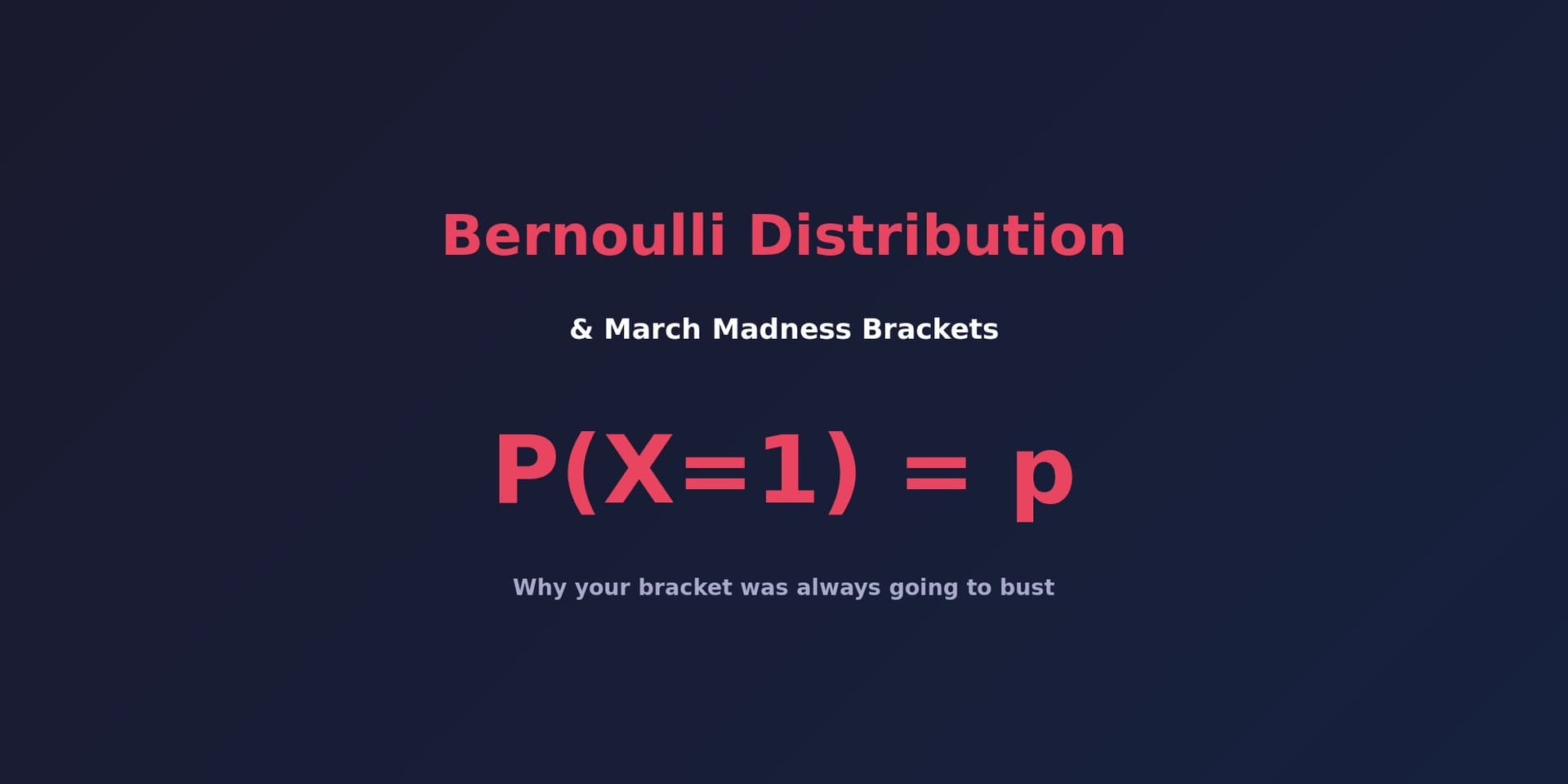
P(X = 1) = p (you pick correctly)
P(X = 0) = 1 − p (you pick incorrectly)
That's the entire Bernoulli distribution. It's the simplest probability distribution that exists. And it's about to ruin your day.
63 coin flips
The NCAA tournament bracket has 63 games (ignoring the First Four play-in games). If you're picking completely at random — flipping a coin for every game — each pick has p = 0.5. The probability of getting every single game right is:
P(perfect bracket) = 0.563 = 1 in 9,223,372,036,854,775,808
That's 1 in 9.2 quintillion. To put that in perspective:
- There are roughly 7.5 quintillion grains of sand on Earth. Your odds of a perfect random bracket are worse than picking one specific grain of sand out of every beach, desert, and ocean floor on the planet.
- If every person who has ever lived (about 117 billion humans) each filled out one bracket per second since the Big Bang (13.8 billion years ago), the total number of brackets attempted would still be about 50 million times fewer than the number needed to expect a single perfect one.
"But I know basketball"
Fair enough. You're not flipping coins. You watch games, you follow the analytics, you know that a 1-seed has historically beaten a 16-seed about 99% of the time. Let's be generous and say you're a genuine expert who picks each game correctly with probability p = 0.67 — two-thirds of the time, better than almost any analyst.
Now when we chain 63 independent Bernoulli trials together, each with p = 0.67, we get a sum that follows the Binomial distribution. The probability that you get all 63 right:
P(perfect bracket) = 0.6763 ≈ 1 in 602,000,000,000
One in 602 billion. Your odds improved by a factor of about 15 billion compared to coin flipping, which sounds impressive until you realize you went from "absolutely impossible" to "still absolutely impossible."
Even at p = 0.75 — an unrealistically high accuracy that no human forecaster sustains over a full tournament — the probability is still roughly 1 in 2.2 billion.
What you should actually expect
Here's where the Bernoulli distribution offers some consolation. When you sum up 63 Bernoulli trials, each with success probability p, the expected number of correct picks is:
E[correct picks] = n × p = 63 × p
| Your skill level | Probability per game (p) | Expected correct picks | Expected wrong picks |
|---|---|---|---|
| Pure coin flip | 0.50 | 31.5 | 31.5 |
| Casual fan | 0.60 | 37.8 | 25.2 |
| Knowledgeable fan | 0.67 | 42.2 | 20.8 |
| Expert analyst | 0.72 | 45.4 | 17.6 |
| Unrealistically good | 0.80 | 50.4 | 12.6 |
So if you're a reasonably knowledgeable basketball fan, you should expect to get around 42 games right and 21 games wrong. Getting 21 games wrong isn't a failure — it's the mathematical expectation. It's what should happen.
The standard deviation of a Binomial distribution is √(n × p × (1−p)), which for our knowledgeable fan is √(63 × 0.67 × 0.33) ≈ 3.7. So roughly 68% of the time, you'll get between 38 and 46 games right. All of those outcomes are perfectly normal.
Why upsets destroy brackets
The real mathematical cruelty of March Madness isn't the Bernoulli distribution alone — it's the cascade effect. In a single-elimination tournament, getting one game wrong doesn't just cost you that game. It eliminates a team from your bracket entirely, potentially costing you several downstream picks.
Pick the wrong team in the first round? That's one wrong pick. But if you had that team advancing to the Sweet 16, that's now three wrong picks from a single upset. Had them in your Final Four? Now one upset just destroyed five of your picks. This cascade means the effective p for later-round picks is lower than your raw game-prediction accuracy, because your later picks are conditional on your earlier picks being correct.
This is why brackets tend to collapse in waves. One upset isn't just one wrong answer — it's a chain reaction through the entire structure.
The consolation of Bernoulli
Here's the thing Jacob Bernoulli figured out over 300 years ago that should make you feel better: in any sequence of independent binary outcomes with fixed probability, the results will converge to the expected value over a large number of trials. This is the Law of Large Numbers, and it's the philosophical punchline of the Bernoulli distribution.
You are not failing at your bracket. You are converging to your expected value. The mathematics guarantee that no matter how skilled you are, you will get a substantial number of games wrong. A perfect bracket isn't a test of basketball knowledge — it's a test of absurd, lottery-defying luck.
So the next time someone asks why your bracket is busted, tell them: "It's not busted. It's behaving exactly as the Bernoulli distribution predicts." Then watch their eyes glaze over while you quietly feel better about the whole thing.
The real lesson
March Madness pools aren't won by people who get every game right. They're won by people who get slightly more games right than the competition, particularly in the later rounds where points are weighted more heavily. The Bernoulli distribution tells you that the difference between the winner of your office pool and the person in last place is often just 5-8 correct picks out of 63 — a variance well within the normal statistical range.
In other words, the winner of your pool probably isn't a basketball genius. They just happened to land on the right side of the distribution this time. And so, perhaps, next year will be your turn.
Bernoulli would have liked those odds.